Lessons from trying to turn two acres of Utah desert into a dependable food-producing homestead
I Thought Two Acres Would Feed Us
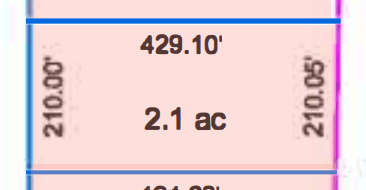
When we moved to Riverbed Ranch and began developing our two-acre homestead, I had a pretty ambitious goal.
Eventually, I thought we could feed ourselves completely.
I didn’t mean that we would somehow reproduce everything we’re accustomed to buying at Costco or the grocery store. Becoming food self-sufficient would also mean changing what we eat.
The idea was fairly simple. We would grow vegetables in our gardens and greenhouses. Our orchard would provide fruit. We would raise chickens and rabbits for meat. What we couldn’t eat immediately, we would preserve for later.
Two acres seemed like plenty of land to do it.
After actually trying to make those two acres productive, I’ve discovered that I was right about one thing and wrong about another.
I still believe we have plenty of land.
In fact, after seeing how much food can be produced when you grow intensively, particularly when you use greenhouse space both horizontally and vertically, I’m confident that we could feed ourselves on considerably less than two acres. I believe we could eventually produce all the food the two of us need, plus a substantial surplus, on one acre.
What I underestimated wasn’t the amount of land we would need.
I underestimated everything that has to happen to turn that land into a dependable source of food.
You have to improve and maintain the soil. Plant the crops. Water them. Protect them from wind, heat, rabbits, birds, antelope, and frost. Harvest them. Preserve them. Store them. And if you’re going to raise meat, you have another living system that requires attention every single day.

Most of all, you have to make the time to do all of that.
I’m learning that the question isn’t really, “Are two acres enough?”
How much of those two acres am I actually willing to develop and maintain?
The Real Limitation Isn’t Land
When I imagined our future homestead, I thought mostly about physical limitations.
Would we have enough land? Enough water? Enough greenhouse space?
What I didn’t think nearly enough about was time.
It turns out that two acres can sit there patiently waiting for you while you do everything else in your life.
My wife is an extrovert, and she enjoys participating in community activities and service projects. She frequently encourages her much more introverted husband to participate too.
We’re also active in our church, which takes time. We travel regularly to Arizona to help care for my wife’s 91-year-old father. And I have a tendency to become interested in projects that have very little to do with getting another garden bed planted.
That’s probably been my biggest obstacle.
I care deeply about building a self-sufficient homestead. But I also care about helping build successful off-grid communities. Right now, for example, I’m working on a business intended to create additional income opportunities for people in our community who are struggling to find the money to finish their own homesteads.
COVID-era inflation made that challenge considerably worse. In our experience at Riverbed Ranch, the price of a 2,400-gallon water tank roughly doubled from before COVID to afterward, while the cost we were seeing for drilling a well rose from around $20,000 to around $30,000. For a family trying to build an entire homestead from scratch, increases like those can consume tens of thousands of dollars they never expected to need.
Given the choice between planting another section of my two acres and working on something that might help several families become more financially secure, I have a tendency to choose the latter.
The garden waits.
That’s one reason that, after several years, I haven’t put even a fourth of our two acres into food production.
I don’t say that as an excuse. It’s actually one of the most useful things this experience has taught me.
When people calculate how much land they need to become food self-sufficient, they tend to think in acres.
But land isn’t necessarily the scarce resource.
Your attention may be.
An acre you have the time and determination to develop may produce far more food than five acres you intend to get around to someday.
What We’re Actually Growing
So what does food production actually look like on our homestead today?
It’s a mixture of encouraging successes, unfinished projects, experiments, and a few failures.
We have two greenhouses.
The first is our taller greenhouse. Some plants left over from last year, including celery, lettuce, beets, and kale, have gone to seed. But the stars this year have been the tomatoes.
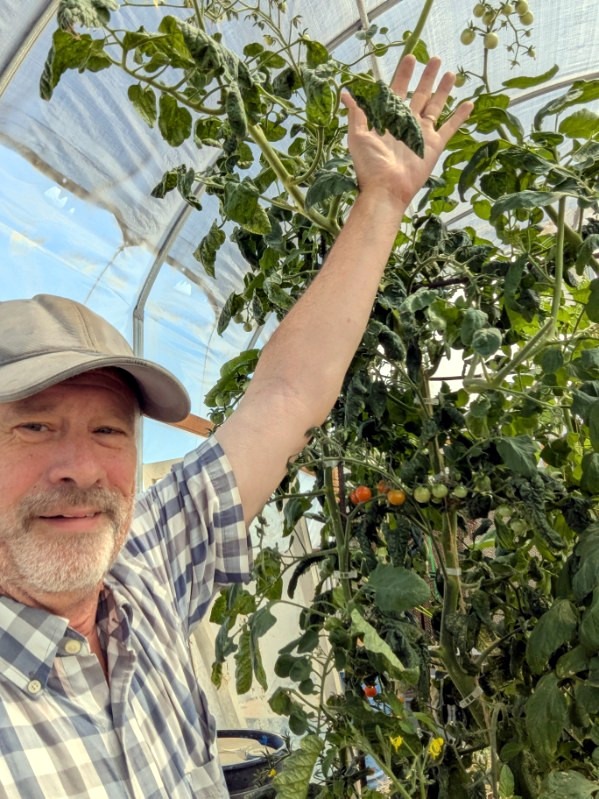
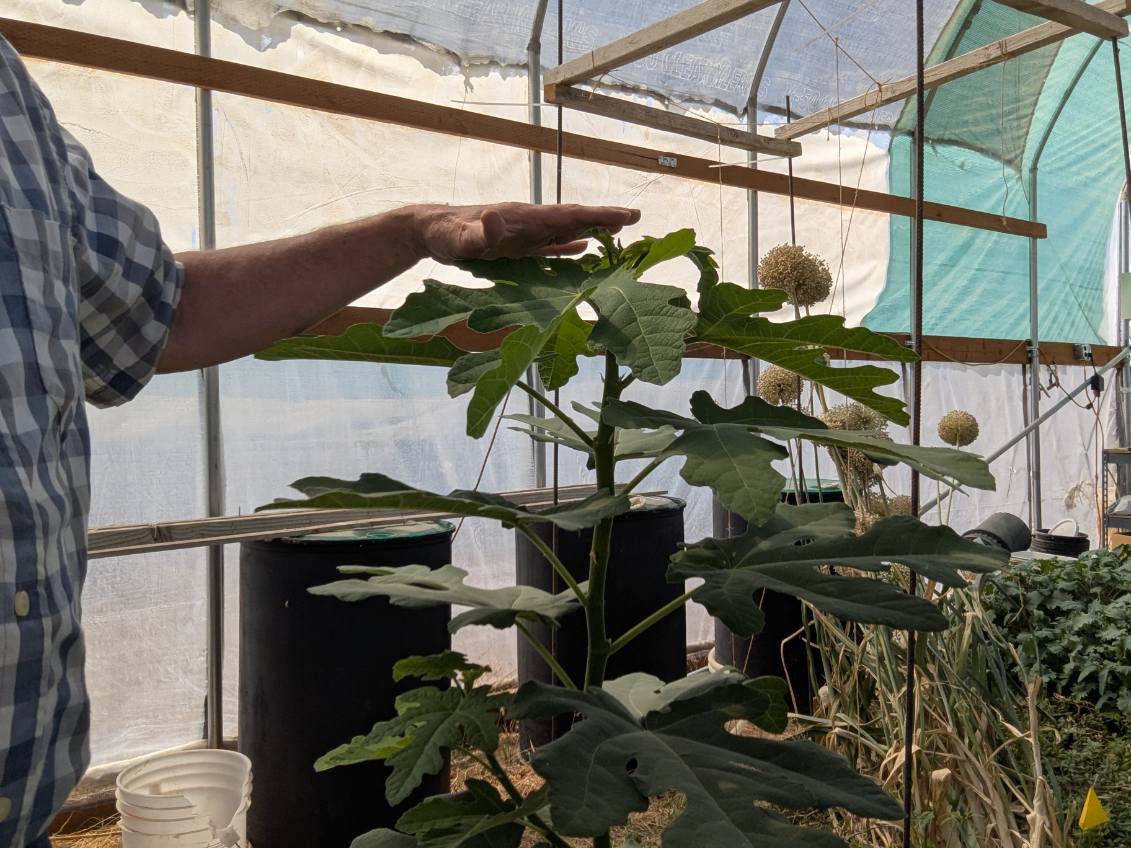
I’ve trained them vertically up strings, removing the lower branches as the plants grow. I learned the technique from a Russian grower I watched on YouTube, and some of my tomato plants are now around eight feet tall. Besides making good use of vertical space, the method makes the tomatoes remarkably convenient to pick.
I also intentionally planted three fig trees and an olive tree down the center aisle. I knew that would eventually make the center aisle unusable, but the greenhouse also has aisles along the east and west sides, so I can still reach everything while using that center space for permanent food-producing plants.
Our second greenhouse runs considerably warmer, and that’s where I’ve had some of my biggest surprises.
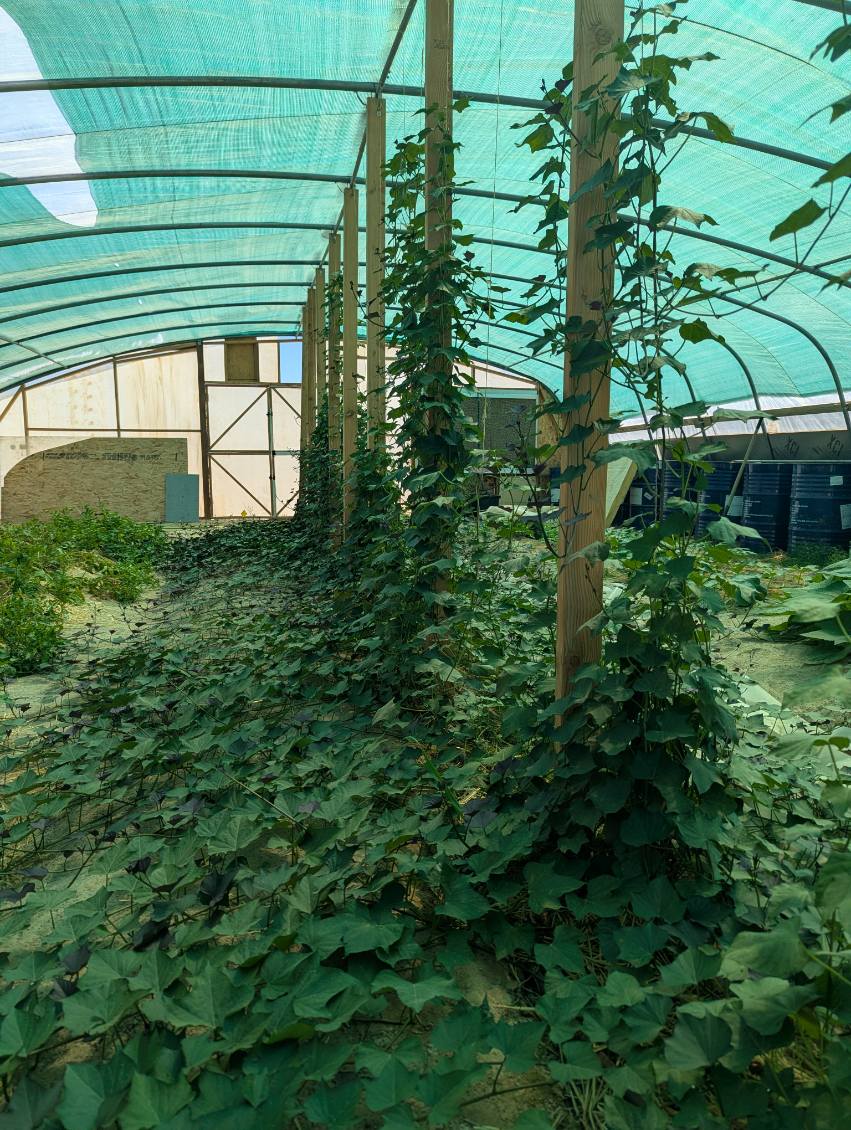
I planted regular potatoes and sweet potatoes. The sweet potatoes have gone crazy. It looks like we’re going to have a bumper crop, which is wonderful except for one small detail I’ll get to later: I haven’t yet figured out where I’m going to cure and store all of them.
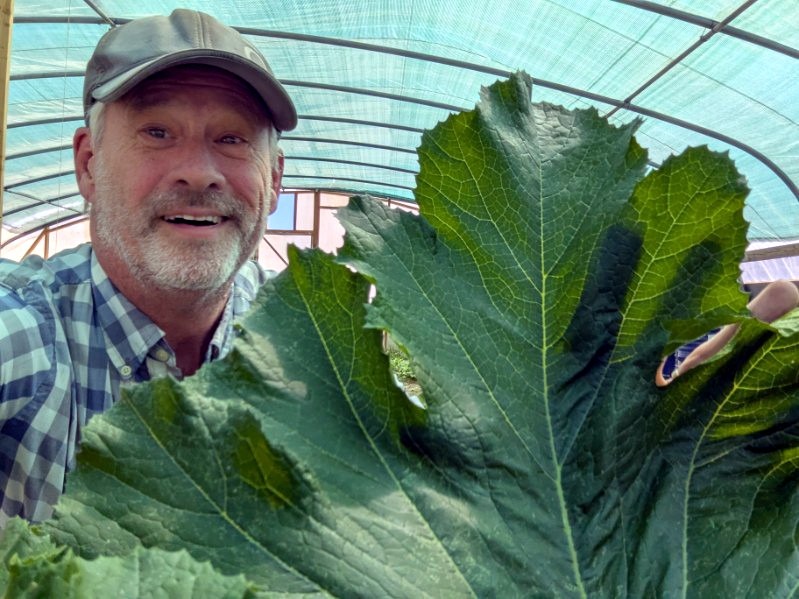
I also have a Japanese eggplant, watermelon, an enormous zucchini plant, and a crookneck squash plant that may be the largest I’ve ever grown.
Not everything has been so successful.
Between the greenhouse and orchard, we planted two 50-foot rows of sunchokes. Other people at Riverbed Ranch have grown them successfully, so I was looking forward to a bumper crop.
The jackrabbits apparently were too.
They dug them up and ate them.
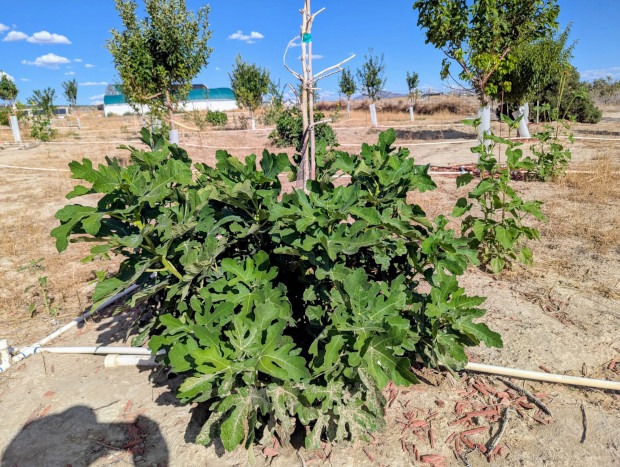
Then there’s our orchard, with 33 trees representing a wide variety of fruit. Three of those are “hardy” fig trees. Our winters kill the trunks and branches back to the ground, and then the figs grow again from the roots, so instead of looking like fruit trees, mine currently look more like two-foot-tall bushes.
Near the house, I have two growing boxes. One contains the survivors of about 50 strawberry plants I put in.
There are approximately five left.
I’m still not certain what went wrong. Heat may have played a role. I didn’t put shade cloth over them until they were already struggling. It could have been the soil, the location, or a combination of factors.
The other box is doing better, with asparagus, Egyptian walking onions, and garlic growing together.
I also have an indoor seed-starting system about six feet tall, with five lighted shelves.
This year I used it to start a lot of plants, and technically it worked very well. I grew plenty of seedlings.
Then I remembered what had to happen next.
Those tender plants couldn’t simply go from grow lights inside the house to the full force of the high-desert sun. They needed to be hardened off, gradually acclimated to outdoor conditions. With that many trays, that meant carrying plants in and out of the house repeatedly while gradually increasing their exposure.
I looked at the amount of work involved and decided that next year I’m going to simplify. I’ll direct-sow considerably more of my seeds into the garden and greenhouses.
That’s another lesson I’m learning about food self-sufficiency: the most sophisticated system isn’t necessarily the best system. If a method creates so much additional work that I don’t want to keep doing it, I need a simpler method.
And then there’s the 50-by-50-foot outdoor garden.
I tried surrounding it with herbs that were supposed to discourage rabbits and mice. My theory was that perhaps I could avoid putting up a fence.
The rabbits and birds solved that problem by eating many of the herb seedlings before they could grow large enough to repel anything.
So I built the fence.
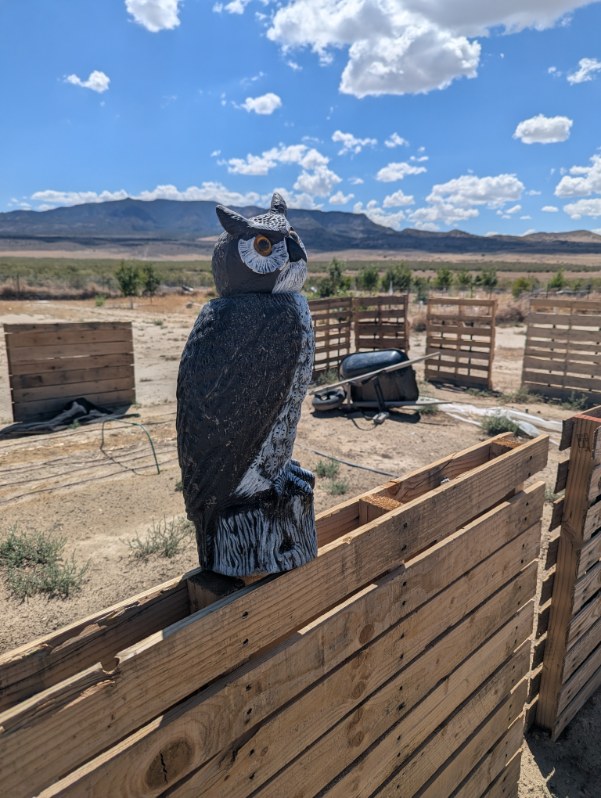
I also bought a fake owl to discourage birds. The desert wind blew it over and broke its head. Now whenever we get a strong wind, the head blows off and I have to go outside and put my owl back together.
Meanwhile, the squash and watermelon growing inside the garden are doing reasonably well.
This is what I’ve discovered food production actually looks like.
Some things thrive beyond your expectations. Some things die for reasons you don’t fully understand. Some things get eaten before you get a chance to eat them.
And sometimes you spend part of your morning putting the head back on an owl.
The Desert Gets a Vote
I’ve gardened for most of my married life, so I didn’t come to Riverbed Ranch without experience growing food.
What I didn’t have was experience growing food here.
In town, there were mature trees everywhere. Houses, fences, and decades-old landscaping broke up the wind. The wind might have been blowing above us, but it wasn’t hitting our garden with the same force it does in the open desert.
Out here, there’s very little between my vegetables and the weather.
That’s why I eventually put windbreaks around our outdoor garden. They help, but even with that protection, the squash growing outside looks considerably more weathered than the enormous squash plants growing inside the greenhouse.
Then there’s the heat.
I’ve considered putting shade cloth over the entire outdoor garden. One of my neighbors a few lots away shades most of his garden, and his plants look remarkably healthy and happy.
The wildlife presents another challenge.
We had raccoons occasionally raid our garden when we lived in town. Out here, if I didn’t have fencing, the rabbits would raid my garden every day.
And rabbits aren’t the largest animals interested in what we’re growing.
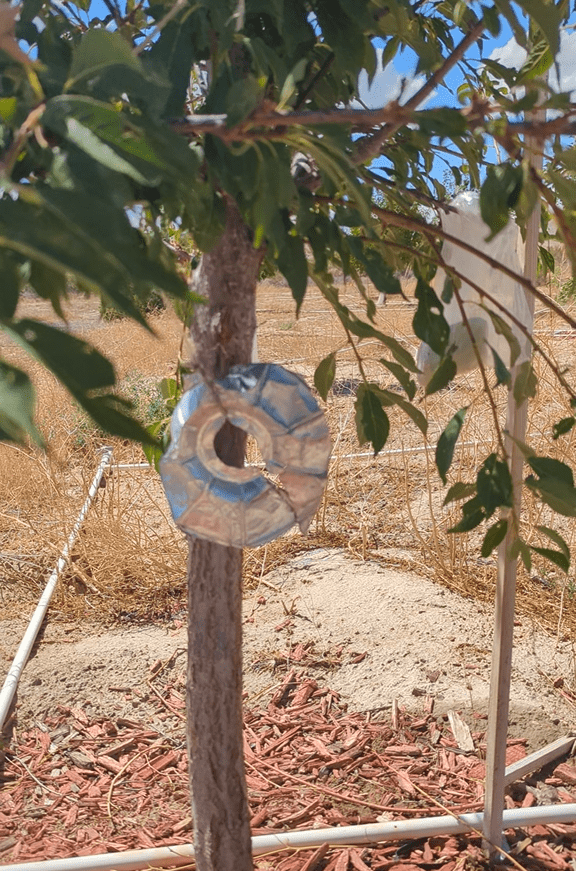
Riverbed Ranch borders Bureau of Land Management land on three sides, and antelope regularly move through the area. Unfortunately, they’ve discovered that the lower branches of my fruit trees make a pretty good snack.
I did some research into possible deterrents and tried a couple of inexpensive ones.
I hung metal stovetop burner drip pans from the trees. When the wind moves them around, they make an unfamiliar metallic noise that seems to discourage the antelope. I’ve also hung pieces of strongly scented Irish Spring soap from the trees.
Both seem to help, at least temporarily.
But this is the desert, so nothing is quite that simple.
Eventually the soap loses its smell. And our wind has a habit of blowing the metal drip pans right off the trees, so I periodically have to replace them.
Apparently, growing an orchard sometimes includes hanging soap and pieces of your stove from fruit trees.
And then there is frost.
This year our 33-tree orchard taught me one of the harder lessons about relying on perennial food crops.
We had two frosts at just the wrong time.
They killed the blossoms.
Every last one.
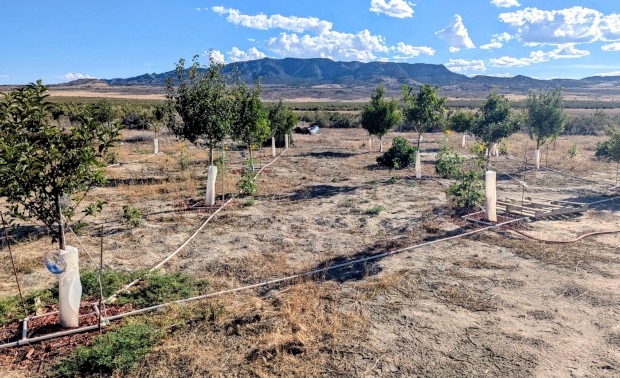
So this year, despite having 33 fruit trees, I have no fruit.
That’s a sobering experience when you’re thinking about an orchard as an important part of feeding yourself. Planting 33 fruit trees isn’t the same thing as having a dependable source of fruit.
If I can’t find an economical way to reduce the danger from those late frosts, there’s every reason to believe it could happen again.
Interestingly, the soil has been less troublesome than its appearance might suggest.
Our soil is rather gray, with plenty of sand and clay, and when you first look at it, you might not expect much from it.
But it grows plants.
I’m continuing to work on improving it with organic material and experimenting with ways to build healthier soil over time.
All of this has changed how I think about growing food.
A seed packet may tell you what a plant needs.
But it doesn’t know about the wind across your particular garden, the jackrabbit living nearby, the antelope browsing your orchard, the frost that arrives two days after your fruit trees blossom, or the afternoon heat reflecting off your particular piece of ground.
You don’t just learn how to garden.
You have to learn how to garden where you are.
Growing Vegetables Isn’t the Same as Feeding Yourself
It’s easy to walk through a garden full of tomatoes, squash, lettuce, and peppers and feel like you’re becoming food self-sufficient.
And you are.
But there’s a difference between growing a lot of vegetables and producing enough food to sustain two adults throughout the year.
You need calories.
You need protein.
That’s one reason I’m so encouraged by what’s happening with our potatoes and sweet potatoes. They’re the kinds of crops that can contribute substantially more calories than a basket of salad greens.
My biggest missing piece right now is meat.
From the beginning, my plan has been to raise chickens and rabbits. I already own cages for both.
They’re still in the boxes.
Part of my hesitation is very human. I’m not particularly excited about raising an animal and then having to kill and process it.
But there’s another issue I’ve been thinking about.
I don’t want to call myself food self-sufficient because I’m raising chickens and rabbits while constantly driving into town to buy bags of feed to keep them alive.
That seems kind of silly.
So before bringing in the animals, I want to establish an area specifically for producing food they can eat. I’m envisioning a fairly large growing area with plants they can forage from, along with a couple of fruiting trees and larger plants. Surplus fruits and vegetables from our gardens could supplement that.
Whether I can actually produce all of their feed that way remains to be seen.
And that’s an important qualification.
Chickens and rabbits have nutritional requirements that can’t simply be ignored because we’d prefer not to buy commercial feed. If what I grow provides only part of what they need, I’ll supplement it rather than compromise the health of the animals.
But the goal is still worth pursuing.
Every portion of their feed that I can sustainably produce here reduces another outside dependency.
That’s the larger lesson I’m beginning to understand.
Food self-sufficiency isn’t measured by how many things you’re growing.
It’s measured by how much of the chain you can provide for yourself.
Growing a tomato is one link.
Growing enough calories is another.
Producing protein is another.
Producing some of the food that produces your protein takes you one step farther.
And even after you’ve accomplished all of that, you’re still not finished.
Because eventually the harvest arrives.
Then you have to figure out what to do with it.
A Harvest Isn’t Food Security Until You Can Store It
Right now, I have what appears to be a very successful crop of sweet potatoes growing in our second greenhouse.
That’s the good news.
The bad news is that I’m not prepared to deal with them.
Sweet potatoes need to be properly cured after harvest if you want to store them successfully for an extended period. I know that now.
What I don’t yet have is a place set up to do it.
It’s a good problem to have, but it has exposed another weakness in my food-production system.
I’ve spent a lot of time thinking about how to grow food.
I haven’t spent nearly enough time thinking about what happens after I grow it.
We aren’t complete beginners at food preservation. My wife and I have two dehydrators, and we’ve dehydrated plenty of food over the years. We have a good supply of canning jars and lids and experience canning food.
We’ve dabbled a little in fermentation.
But our freezer space is basically limited to the freezer attached to our refrigerator.
And we don’t have a root cellar.
Yet.
I’d like to build an above-ground root cellar next to the north side of our shipping container. That location should help keep it out of direct sun, and a properly designed and insulated structure could give us the cool storage space we currently lack.
I wish I had thought more seriously about food storage when we built the house.
Had we put in a basement instead of a crawl space, I could have incorporated a root cellar into the original design. Some of our neighbors have done exactly that.
I’m a little envious.
Because here’s something that should have been obvious from the beginning:
Growing enough food to last a year doesn’t do much good if much of it spoils before you can eat it.
Food production and food preservation aren’t separate hobbies.
They’re parts of the same system.
A productive homestead needs places for food to go when the harvest comes in. Some foods need to be canned. Some can be dehydrated. Some can be fermented. Some can be frozen. Others can be cured and stored under the right temperature and humidity conditions.
And ideally, you don’t discover which system you’re missing while staring at a bumper crop that’s almost ready to harvest.
That’s where I am with the sweet potatoes.
So while I continue expanding what we grow, food preservation has moved much higher on my priority list.
Because the real goal isn’t simply to grow enough food.
It’s to still be eating that food months after the garden has gone quiet.
So, Are Two Acres Enough?
After everything I’ve described, you might expect me to say that two acres isn’t enough land to feed two people.
I believe the opposite.
I’m increasingly convinced that our two acres are considerably more land than my wife and I actually need to feed ourselves.
If I gave food production my full attention, I believe we could produce all of our food, plus a substantial surplus, on one acre.
That’s my conclusion from working with our own land. I’m not presenting one acre as a scientifically established number that will work for every family in every climate.
There are simply too many variables for that.
But I’ve seen what happens when we use space more intensively.
My tomato plants are a good example. Instead of allowing them to sprawl across the greenhouse floor, I’ve trained them up strings. Some are now about eight feet tall. I’m producing tomatoes vertically in space that otherwise would have been mostly empty air.
The same principle can be applied throughout a homestead.
You can grow horizontally across the ground and vertically into the space above it. Greenhouses can extend growing seasons and allow much more intensive use of a relatively small footprint. Succession planting can allow the same piece of soil to produce more than one crop during a season.
The question becomes less about how many acres you own and more about how effectively you use the space you have.
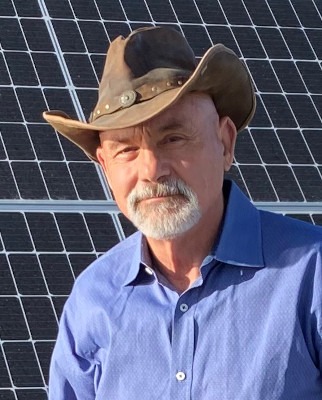
Philip Gleason repeats a saying on nearly every tour of Riverbed Ranch:
“It’s not what you have — it’s what you do with what you have that matters.“
That saying particularly resonates with me because, for the first four years of Riverbed Ranch, I handled our marketing.
I was surprised by how often prospective residents would turn up their noses at our two-acre homesteads. Some were convinced they needed 10 or 15 acres to become self-sufficient. Others wanted 20. Some insisted they needed 40.
I remember thinking, What are you going to do with 40 acres?
More land can certainly make sense if your plans include grazing beef cattle, traditional commercial agriculture, or other land-intensive uses. But acreage by itself doesn’t produce anything.
Forty acres that you don’t have the time, water, money, or energy to develop may contribute less to feeding your family than a fraction of an acre that you manage intensively.
After trying to produce food on my own two acres, I’m more convinced of that than ever. I haven’t even put a fourth of our property into food production yet, and my limiting factor isn’t land. It’s how much of that land I have the time and determination to put to productive use.
Research into controlled-environment agriculture reinforces the larger idea that relatively small spaces can produce substantial amounts of food. The University of Arizona, for example, developed a prototype lunar greenhouse in connection with NASA research to study food production, water recycling, and air revitalization in a compact controlled system.
Disney’s EPCOT has likewise demonstrated innovative greenhouse techniques and high-yield crops at its Living with the Land attraction, where some of the produce grown in the greenhouses is served in EPCOT restaurants.
I don’t think those projects give us a magic number of square feet that guarantees a complete diet. What they do reinforce is something I’m seeing on a much more ordinary scale in my own greenhouses: when you grow intensively and use vertical space, a surprisingly small footprint can produce a remarkable amount of food.
Still, asking whether an acre can grow enough food is only part of the question.
Can I protect it from rabbits, birds, antelope, wind, heat, and frost?
Can I produce enough calories?
Can I produce protein?
Can I grow at least some of the feed for the animals producing that protein?
Can I preserve the harvest?
Can I store enough food through winter?
And perhaps most importantly:
Will I devote enough time and energy to actually do all of it?
That’s where my own homestead currently falls short.
Not acreage.
Focus.
The land is here.
The potential is here.
Whether I turn that potential into a truly food self-sufficient homestead is largely up to me.
You Don’t Need Two Acres to Start
There’s a danger in an article like this.
Someone can read about our two acres, two greenhouses, 33 fruit trees, outdoor garden, and plans for chickens and rabbits and conclude, Well, that’s nice for you. I don’t have any of those things.
You don’t need them to start.
If you have a backyard, explore square-foot gardening and other intensive-growing methods. See how much food you can produce from a surprisingly small patch of ground.
If you live in an apartment, look at your porch or balcony.
Could you grow tomatoes in buckets?
Peppers?
Herbs?
Maybe everything you need to make your own salsa?
You aren’t going to feed yourself for a year from a few buckets on an apartment balcony. But that’s not really the point.
You’re producing something.
You’re learning how plants grow. You’re learning what your particular space will support. You’re becoming a little less dependent upon someone else producing everything you eat.
And next year you can do a little more.
I’ve thought about self-reliance this way for a long time. In fact, it’s one of the ideas behind an e-book I wrote called Your Matrix Exit Plan.
The book looks at self-reliance as a continuum rather than an all-or-nothing decision.
At one end might be someone living in an apartment who begins growing a little food on a balcony. Farther along might be a family with a backyard garden, food storage, and some ability to provide its own energy or water.
Farther still might be someone like us, living on an off-grid homestead and trying to produce most or eventually all of what we need.
And beyond the individual homestead is another step that has become increasingly important to me: doing this within a community where people can help one another become more resilient.
You don’t have to jump from one end of that continuum to the other.
You don’t have to wait until you can afford acreage.
And you certainly don’t have to have everything figured out before you begin. If that were a requirement, I would still be waiting.
Start with the space you have.
Grow something you actually like to eat.
Learn from what works.
Learn even more from what doesn’t.
Preserve something.
Then do a little more next year.
It’s not what you have. It’s what you do with what you have that matters.
Research notes
University of Arizona: Prototype BLSS Lunar Greenhouse and related controlled-environment agriculture research describe a compact prototype designed to demonstrate food production, water recycling, and air revitalization for sustained human presence in space.
Walt Disney World: Living with the Land describes innovative growing techniques and high-yield crops, with produce from The Land greenhouses served at EPCOT restaurants.
Leave a Reply