The first night we slept on our property at Riverbed Ranch, our house didn’t even have a roof.
We had a crawl space, a floor, and two partial walls. We set up our cots and slept under the stars.
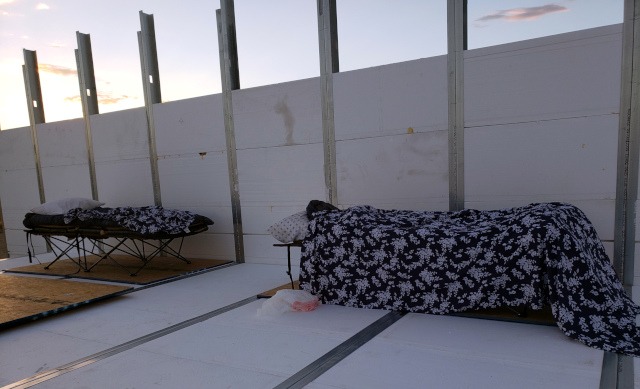
I don’t remember seeing or hearing any mice that night.
They apparently waited until we finished the house.
Once the exterior walls and roof were up and I slept inside, I started hearing scratching. I don’t remember whether I heard mice in the walls first or discovered mouse droppings in a kitchen drawer first.
Either way, I quickly learned something I hadn’t fully appreciated before moving to the Utah West Desert.
We weren’t just building a homestead.
We were building it in somebody else’s habitat.
I Thought the Animals Would Move Away
Before moving here, I suppose I assumed that as Riverbed Ranch developed and people built homes, most wild animals would naturally steer clear of us.
That hasn’t exactly happened.
We have mice under the house. Rabbits live underneath my shipping container. Antelope have walked into my orchard. Coyotes cross my yard.
I’ve watched hawks overhead, seen an owl flying low at night, watched crows spend much of a day circling our end of the community, and once watched a large nonvenomous-looking snake crawl across my property.
And then there are the wild horses, which I thoroughly enjoy seeing run past the property.
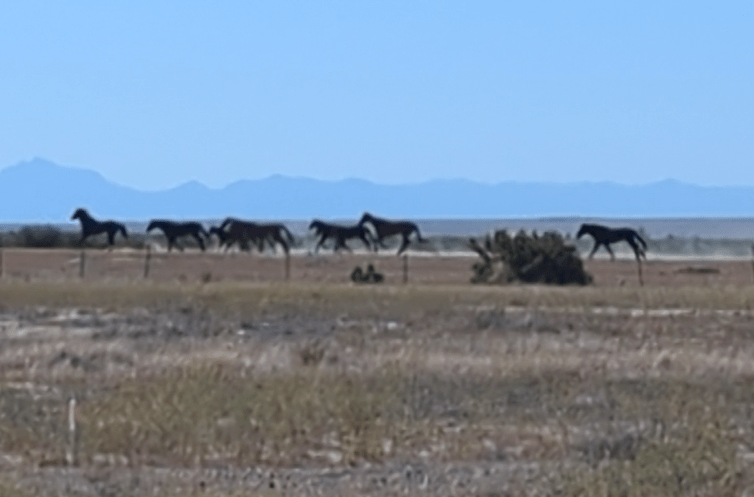
After five years here, I’ve learned that living closer to nature means exactly that.
You live closer to nature.
Sometimes nature is beautiful.
Sometimes it eats your garden.
The Mice Were First
My first response to discovering mice was probably the same response a lot of people would have.
Mouse traps.
I put traps underneath the house. They worked, but I eventually got tired of crawling under there to deal with traps that had caught mice.
So I switched to mouse bait.
That reduced the problem, but it didn’t solve the underlying issue. I crawled around and sealed every opening I could find, but mice can burrow beneath the foundation and find their way into the crawl space.
As far as I know, they haven’t caused significant damage to the house. But I have learned that keeping them out is an ongoing job rather than something I have permanently solved.
If I were building this house again, I would make one major change.
I’d build a basement.
I already wish I had one for storing food and supplies. But a concrete basement would also eliminate much of the accessible space underneath the house that mice now like to visit.
That is one of those decisions that seems unrelated to wildlife when you are drawing house plans.
Five years later, it doesn’t seem unrelated at all.
Then the Rabbits Discovered the Garden
I knew we had rabbits from the beginning.
Walk outside early in the morning and you can see them scatter. There is a family that lives underneath my shipping container.
I thought I had a plan for them.
I intended to grow herbs around the perimeter of the garden that rabbits supposedly don’t like.
There was one flaw in that plan.
The rabbits were perfectly happy to eat the sprouts.
It doesn’t matter much whether a rabbit dislikes the mature plant if it eats the plant before it ever gets a chance to mature.
Fortunately, I already had another structure around the garden. Because wind is a serious issue here, I had stood wooden pallets vertically around the garden, roughly a foot apart, to serve as windbreaks.
When it became obvious that the rabbits were winning, I adapted what was already there.
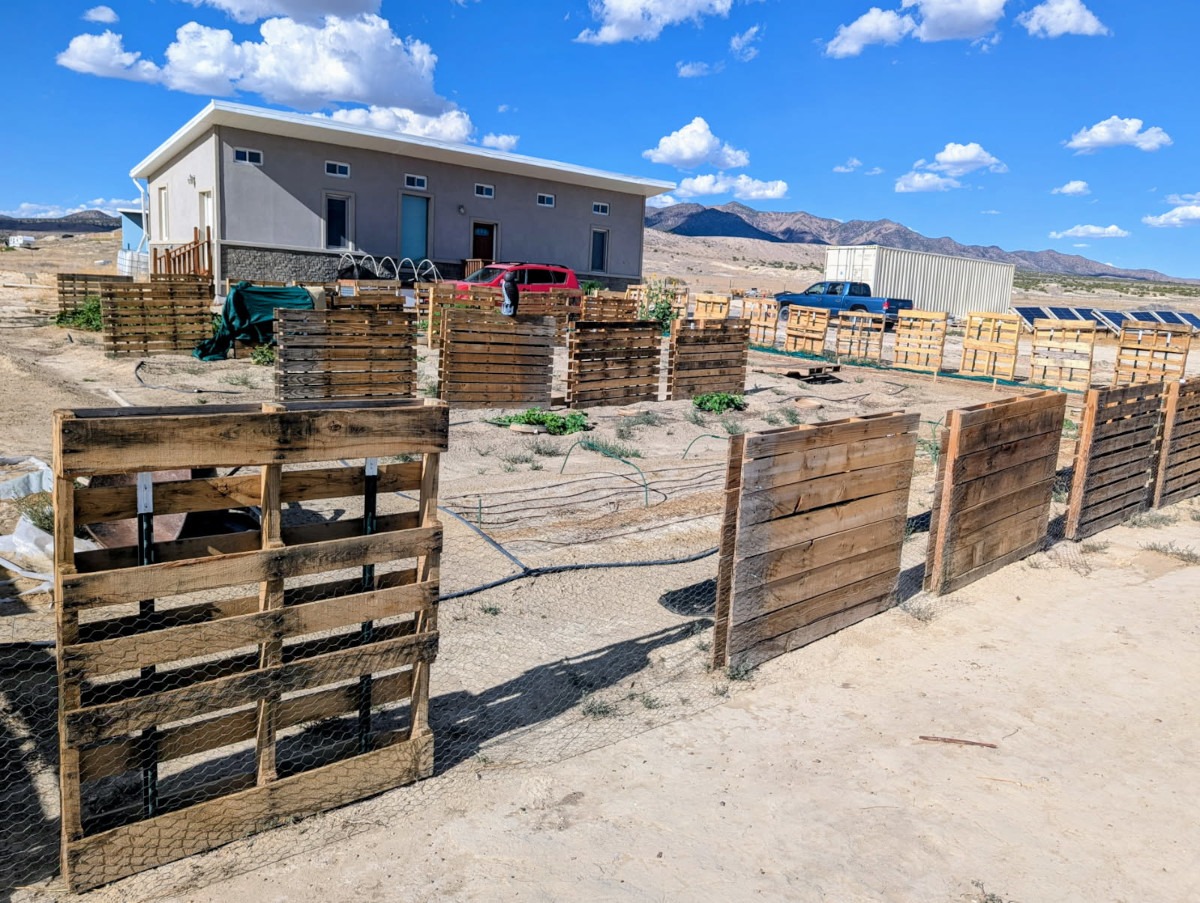
I wrapped chicken wire around the bottom of the pallets all the way around the garden. Rather than burying the wire, I left about six inches extending horizontally along the ground to discourage rabbits from digging underneath it.
So far, I haven’t seen evidence that they’ve gotten through.
The rabbits still live around me. Some apparently still live under my shipping container.
I just don’t care as much anymore.
The garden is protected.
The Antelope Found the Orchard
The rabbits went after seedlings.
The antelope went after trees.
The first time I realized antelope had entered my orchard, they had stripped leaves from the lower branches of a number of fruit trees. They had also chewed off some of the smaller branches.
I considered fencing the entire orchard.
I already have windbreak fencing on the north and south sides because those are our predominant wind directions, but it is only about 50 inches tall. A determined antelope can clear that without much trouble.
I could have installed more substantial fencing.
But fencing costs money, and I wanted to do something immediately. I didn’t want to wait and see whether the antelope came back the following night.
So I started researching what other people had successfully used to discourage deer and similar animals.
That research led to a considerably cheaper trip to the dollar store.
Irish Spring and Aluminum Drip Pans
The closest town is about 50 miles away. I drove in and bought Irish Spring soap, disposable aluminum stove-top drip pans, and every hair net the store had available.
I put bars of soap into the hair nets and hung them low in the trees.
When I ran out of hair nets, we improvised. We put the soap into sandwich bags, cut off the lower corners so the scent could escape, punched holes near the top, and hung those from small branches.
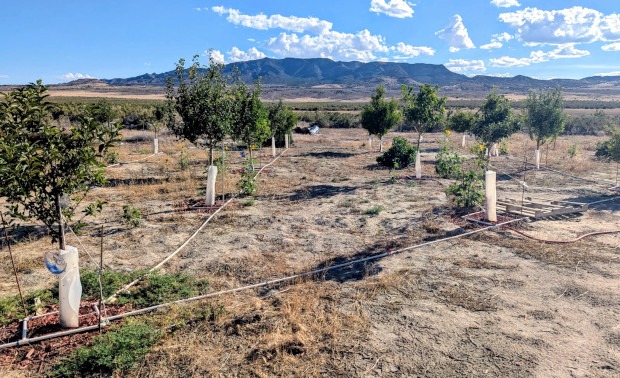
For the aluminum drip pans, I made loops from fencing wire, poked the wire through the pans, and hung them from branches where the wind could move them around.
The idea I had found online was that the combination of unfamiliar reflections, movement, noise, and human-like scent might discourage deer and similar animals.
I can’t tell you scientifically which part worked, or whether it was the combination.
I can tell you what happened on my property.
The antelope stopped damaging my trees.
For a long while.
Cheap Solutions Still Need Maintenance
Eventually the soap developed a hardened outer layer and didn’t smell nearly as strong.
The wind also took its toll on the thin aluminum pans. Constant movement eventually caused some of them to tear around the wire and fall off.
When I replaced them, I started folding over one side of the aluminum before pushing the wire through it. That gave the wire a thicker section of aluminum to hold onto and helped the pans last longer.
I’ve refreshed the Irish Spring twice.
The first time may have been after several months, perhaps around six. The second time was after another long stretch when I discovered fresh antelope damage in the orchard.
And the antelope apparently left me a review.
I had placed some soap near the east side of the orchard in hopes of discouraging them from entering at all. After its scent had faded, I discovered that an antelope had deposited its bodily waste directly on top of one of the pieces of soap.
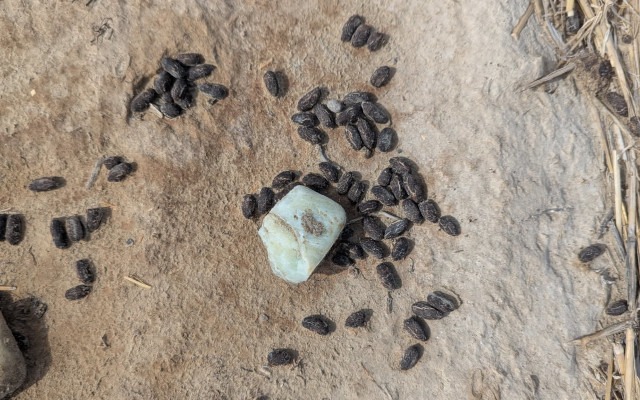
Message received.
The deterrents require maintenance.
Still, compared with the cost of fencing an entire orchard, refreshing some soap and replacing aluminum drip pans occasionally has been a trade I’m willing to make.
Coyotes Are Different
My first coyote encounter happened while driving home at night.
I turned a corner a couple of lots from my house and my headlights caught a coyote running across the road.
Another encounter was considerably closer.
One evening I heard a neighbor’s rifle and assumed he was shooting at coyotes. I walked to my front door, stepped onto the porch, and there was a coyote casually loping across my front yard.
At the moment, coyotes don’t concern me very much.
I don’t have chickens or rabbits — yet. Neighbors who do raise animals have much more reason to worry about them.
I’ve occasionally wondered whether I should help remove coyotes. Utah has even offered incentives for coyote removal.
But then another question occurs to me.
What else are the coyotes eating?
We already have plenty of rabbits around here. I’m not particularly eager to remove a predator simply because it happens to cross my property.
That doesn’t mean coyotes should never be controlled. Someone protecting livestock may reach a very different conclusion.
It means I’ve become less inclined to assume that every wild animal I encounter is a problem I need to solve.
We Aren’t as Separate From Nature as We Think
One neighbor learned this rather dramatically.
Before he had built a house, he was living in an RV. During the summer they sometimes slept with the door open.
Very early one morning, while it was still dark, his cat began making unusual noises.
He turned on a light and looked toward the open door.
What he saw was the back end of a mountain lion leaving his RV.
That story reinforced something I had been slowly learning myself.
Building homes in an area doesn’t necessarily create the invisible boundary between civilization and wildlife that we might imagine.
The animals were here first.
Some adapt to us.
Some avoid us.
Some barely seem to care.
Observe Before You Build
Permaculture teachers often encourage people to spend considerable time observing new property before deciding where everything should go.
Watch where water travels during a rainstorm.
Learn where the prevailing winds come from.
Observe the sun throughout the seasons.
Notice the hot and cold areas.
I would add one more item to that list:
Watch the animals.
What already lives there?
Where do they travel?
What eats the vegetation?
Are there predators?
Are there snakes?
What might threaten an orchard, garden, chickens, rabbits, goats, or other animals you plan to raise?
If I had understood that principle more fully at the beginning, I might have made some different decisions.
The mistake is assuming that because you’re building a home, the wildlife will simply move somewhere else.
It might not.
Sometimes You Just Enjoy the Show
Not every encounter needs a solution.
I enjoy seeing the wild horses run past our property.
I enjoy watching real cowboys on horseback round up cattle that water at a spring a few hundred yards east of my house.
And driving through Utah’s West Desert occasionally brings its own surprises.
More than once I’ve come over a hill on the way home and suddenly found sheep everywhere. Not a few dozen. An entire valley can appear to be covered with them.
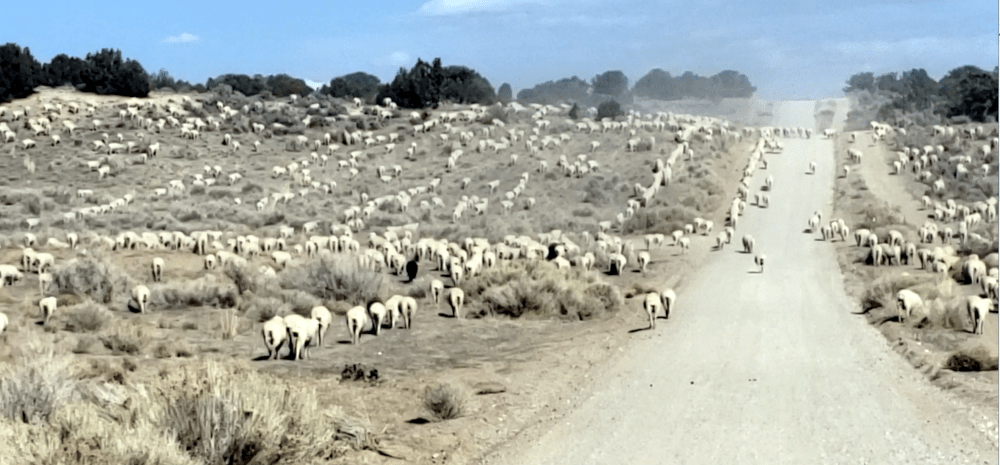
The first time it happened, I thought I needed to stop and wait for the sheep to get a clue, or, the shepherd to clear a path.
Eventually I learned to simply drive forward very slowly. The sheep move.
Life out here is different.
In town, most of the animals you encounter regularly are somebody’s cats and dogs. Out here, we share the landscape with animals that don’t belong to anybody.
Some need to be kept out of the garden.
Some need to be discouraged from eating the orchard.
Some need to be kept out from under the house.
And some are worth stopping what you’re doing for a few minutes just to watch.
The rabbits still live underneath my shipping container.
But now that the garden is protected, I don’t throw rocks at them anymore.

Leave a Reply