Living off-grid sounded pretty straightforward when we started.
Buy enough solar panels. Buy some batteries. Install an inverter. Let the Utah sun provide the electricity.
I understood from the beginning that the size of the system we could afford would place some limits on how we lived. What I didn’t understand was how much I was about to learn about electricity, batteries, timing, redundancy, rodents, well pumps, and expensive mistakes.
That’s one of the differences between living in the city and living off-grid.
In the city, you flip a switch and electricity appears. Somewhere, somebody understands the system that made that happen.
When you’re off-grid, you’re your own utility company.
And sometimes your fantasy of self-reliance has to meet reality.
We Started With a Good Inverter and Not Enough of Everything Else
Following the recommendation of Riverbed Ranch founder Philip Gleason, I purchased a Sol-Ark 12K EMP-hardened inverter.
It was top-of-the-line equipment and considerably more expensive than some of the alternatives.
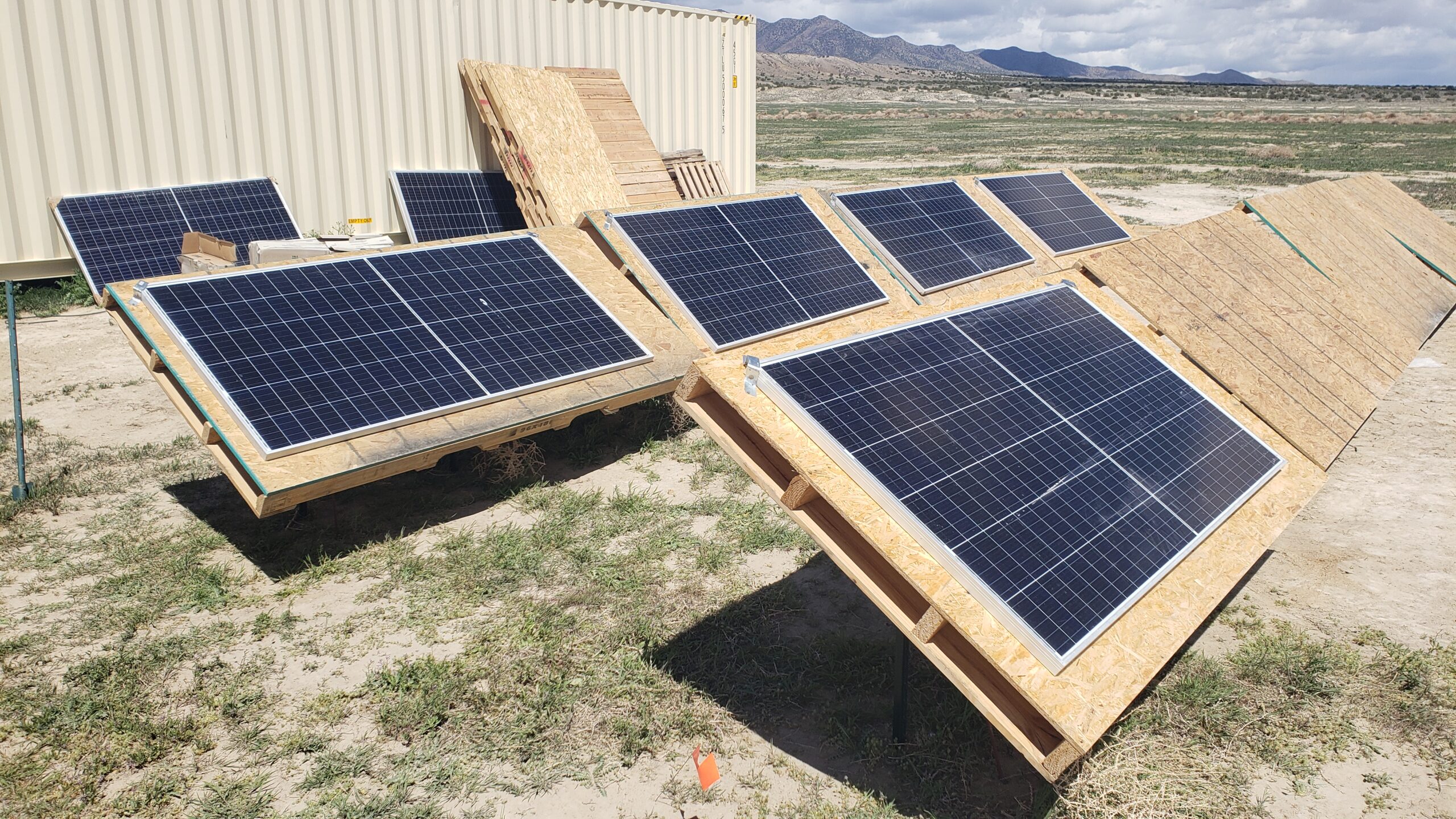
We initially paired it with eight partially charged carbon batteries and eight solar panels, all facing south.
The batteries proved woefully inadequate.
While our house was being finished, we rented it to the handyman doing much of the interior work. He regularly complained that the power system shut down, usually in the evening.
I’m pretty sure he wasn’t being as careful with electricity as we would eventually learn to be. But his frustration was legitimate. The system simply didn’t have enough reserve for the way he was using it.
A neighbor later changed to a different, less-expensive battery system and sold me eight of his PCC batteries.
That brought us to 16.
Things got better.
Then I made one of the most expensive mistakes of my off-grid education.
The Paragraph I Really Wish I Had Read
When I connected the additional batteries, I didn’t ask anyone for guidance.
I also didn’t read the one little paragraph in the manual that told me how the batteries needed to be connected.
I wired them incorrectly.
The result was spectacularly bad.
I burned my expensive 12K inverter to a crispy crunch.
That lesson cost me thousands of dollars.
I was persuaded to replace it with Sol-Ark’s larger 15K inverter. By the time we were done, the replacement was pushing five figures.
That expense had consequences beyond the electrical system. We had been hoping to buy a good truck. After buying the inverter, we couldn’t afford the truck we wanted.
There is a temptation when becoming self-reliant to believe that doing things yourself means figuring everything out yourself.
I’ve learned otherwise.
Self-reliance still requires knowing when to read the instructions and when to ask someone who knows more than you do.
That may have been the most expensive paragraph I ever failed to read.
Then Our Well Pumps Started Disintegrating
Our battery bank wasn’t our only problem.
We went through several well pumps.
And I don’t mean they simply stopped working.
One pump was only a few months old and looked almost as if it had been struck directly by lightning. Part of its casing appeared to have been blown away.
Another looked as though metal-eating termites had attacked it.
Something was very wrong.
Eventually, a patient neighbor started troubleshooting the entire system instead of simply replacing another pump.
We discovered damaged electrical wiring associated with our solar installation and the well. A mouse had chewed through wiring, and we had an unwanted electrical condition involving the well system.
The diagnosis was that stray DC current was contributing to severe electrolytic corrosion of the submerged pump.
Once the underlying electrical problem was corrected, the repeated pump failures stopped.
The experience taught me two lessons.
First, when the same component repeatedly fails, stop assuming the component is the problem.
Second, electrical cables buried around an off-grid homestead need protection. If I were doing that installation again, those vulnerable cables would be protected in appropriate underground conduit rather than simply buried in dirt.
Sometimes the cheapest installation is only cheap until you have to replace several well pumps.
One of My Favorite Changes Was Surprisingly Simple
We originally had eight solar panels, all facing south.
Later I purchased eight more.
Instead of pointing all eight south, I faced four directly east and four directly west.
I really like the result.
Some neighbors with predominantly south-facing arrays tell me their batteries don’t really start charging until later in the morning.
Mine begin receiving useful solar energy around sunrise.
Then the west-facing panels keep producing later in the day as the sun moves toward the horizon.
I haven’t conducted a controlled experiment comparing the two arrangements, so I’m not claiming that my configuration produces more total energy than a properly designed south-facing array.
That’s not why I like it.
I like when it produces electricity.
Our solar day is stretched out.
For an off-grid household, that can be tremendously useful because we’re not merely trying to maximize total production. We’re trying to match production with the hours when we actually consume electricity.
We’ve Learned to Live With the Sun
Living within the limitations of our system hasn’t been a tremendous hardship.
It has mostly required awareness.
The electric stovetop and oven are among our biggest household loads. So if the batteries aren’t fully charged, we don’t start baking.
We save laundry for sunny days.
On cloudy winter days, we become even more conservative. We may turn off the electric water heater, postpone laundry, use less hot water, and eat sandwiches instead of preparing a meal that requires the oven.
During the hottest summer days, our greenhouse swamp coolers can run all day. Those are also the days when we’re trying hardest to keep the house comfortable.
We installed an efficient mini-split and deliberately purchased energy-efficient household appliances.
And I’ve adjusted my expectations.
On a really hot day, I’m perfectly happy with the house at 75 degrees instead of insisting on 70.
None of these adjustments feels particularly burdensome anymore.
We simply think about electricity differently.
The App Changed How We Manage Electricity
One feature of the Sol-Ark system that I particularly appreciate is being able to monitor our batteries from inside the house.
That information changes decisions.
Instead of wondering whether we have enough power to run something, we can look.
Are the batteries full?
Is solar production strong?
Is today a good day to do laundry?
Can we bake something this afternoon?
Living off-grid turns electricity from an invisible commodity into a resource you can watch being produced and consumed.
I actually like that.
Backup Power Isn’t Backup Power If It Won’t Start
I also purchased a fairly large gasoline-powered generator and connected it to the inverter as backup power.
Our solar system has become reliable enough that we haven’t needed the generator very often. I only remember the house losing power once or twice so far this year.
Usually, if the system shuts down, we turn off unnecessary loads, allow it to reset, and we’re back in business fairly quickly.
Then, on one particularly hot summer day, I discovered something embarrassing.
The starter battery in the generator was dead.
I bought a charger.
That didn’t solve it.
Apparently I need a new battery.
That’s another small lesson I’m glad to learn before a serious winter problem:
Emergency equipment needs to be tested before the emergency.
Our solar system has performed well enough that the generator became easy to forget.
I intend to make sure it is operational before winter.
How Much Convenience Do You Want to Buy?
One of my neighbors approached off-grid power differently.
His wife told him she never wanted to worry about electricity.
So, according to what he told me, he installed roughly 36 solar panels and 36 batteries.
She’s very happy.
I believe he’s even considering adding more panels.
There’s a lesson there too.
Off-grid solar doesn’t have one correct size.
You can spend more money upfront and buy yourself a larger margin of convenience. Or you can install a more modest system and become more deliberate about when and how you consume electricity.
We chose something closer to the second approach.
Most of the time, it hasn’t been a big hassle at all.
But you should decide how much inconvenience you’re willing to accept before you size your system.
What About EMP Protection?
Preparedness was one reason I originally chose an EMP-hardened inverter.
A severe electromagnetic disturbance can come from more than one source. Extreme solar activity can produce geomagnetic disturbances capable of affecting electrical infrastructure, while governments have also studied the potential consequences of a deliberate electromagnetic-pulse attack.
How much money someone should spend preparing for such events is a personal decision.
I’ve learned something else, however: protecting the inverter alone isn’t necessarily the entire solution.
Sol-Ark’s EMP-hardened systems include additional suppressors intended to be installed on appliance power cords and solar-panel wiring. In other words, protecting the heart of the electrical system doesn’t automatically mean every electronic device connected to it has the same protection.
If I were starting from scratch, I’d think carefully about redundancy too.
Someone seriously concerned about EMP resilience might reasonably compare the cost of one premium hardened inverter with other strategies, such as maintaining appropriately protected spare equipment.
That’s not an electrical-engineering recommendation. It’s simply the kind of question I would ask now that I’ve lived with an off-grid system and experienced an expensive inverter failure firsthand.
Preparedness isn’t just about buying the toughest component.
It’s about asking what happens when any component fails.
Would I Do It Again?
Absolutely.
I love living off-grid.
There has been a learning curve, and some of my lessons have been embarrassingly expensive.
But that’s part of what attracted me to a more self-reliant lifestyle in the first place.
City living can condition us to depend on complicated systems we know almost nothing about. We know how to flip a switch, turn a faucet, adjust a thermostat, and start an appliance.
We don’t necessarily know where the electricity or water came from or what it takes to keep those systems operating.
Living off-grid changes that relationship.
I’ve learned when our electricity is produced. I’ve learned which appliances consume the most of it. I’ve learned how much energy we can store. I’ve learned to schedule some activities around sunshine. I’ve learned the value of redundancy.
And I’ve learned that mice apparently don’t respect electrical infrastructure.
Most importantly, I’ve learned that self-reliance isn’t about never making mistakes.
It’s about becoming more capable because of them.
When you’re your own utility company, sometimes the lessons are hard.
But I wouldn’t trade the experience.